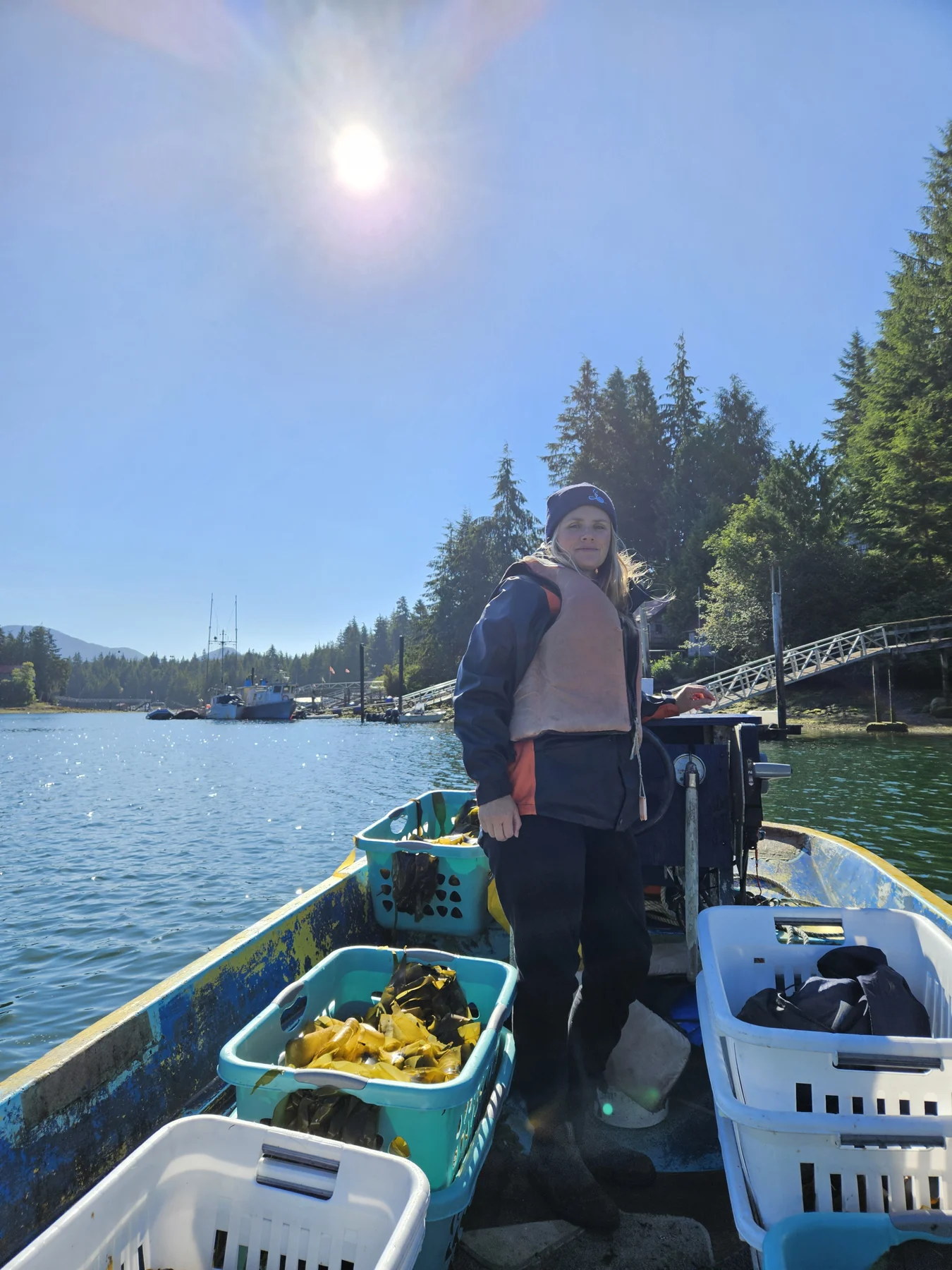
One moment I’m on the water in Canada. The next, I’m in Germany, visiting family at Christmas. Completely different everyday lives, separated by little more than a flight.
That contrast felt especially strong after an autumn of working with the Wei Wai Kum First Nation on kelp farms. I was back in Germany, but my thoughts kept returning to what we had been building together.
Four kilometres of lines and 108 litres of seed material
That autumn, we put around four kilometres of kelp lines into the water together, using 108 litres of KelpSpat™ seed material.
Those lines had the potential to produce more than 20 tonnes of fresh kelp the following spring. That was a projection, not a completed harvest: how much would actually grow depended on how the season developed.
For me, there is something exciting about seeing a shared plan become concrete. Materials, people and work on the water — and then something begins to grow.
Local value and ecological goals
The kelp is more than a raw material. The project aims to create local value and economic opportunities for the community while contributing to the regeneration of marine habitats.
That includes goals such as supporting biodiversity and creating habitat underwater. What those effects look like at a particular site has to be observed over time. The ambition matters, and so does looking carefully at the results.
A project with the Wei Wai Kum
This is not a project “for” the Wei Wai Kum. It is a project with them.
Working together as partners, sharing knowledge and building structures that remain in the hands of First Nations over the long term are central to that work. The relationships matter as much as the technical side.
I’m still involved in the seaweed company today. It is part of the life I’ve built in Canada: working alongside people on something that reaches beyond my own plans.
If you’re wondering how I ended up working with seaweed in the first place, you can read that story here.
The photograph illustrates kelp work in Canada. Further information about the wider project and its partners is available from Canada’s Ocean Supercluster.